
How to Choose Blinds for Your First Home
- WINDOWCOVERINGWIZARD
- Jun 17
- 9 min read

Blinds are window treatments that control light, privacy, and energy efficiency in every room of your home. Knowing how to choose blinds first home buyers will actually use comes down to five priorities: privacy, light control, energy savings, style, and safety. The good news is that selecting blinds for a new home does not require a design degree. You match each room’s function to the right blind type, and the decisions become straightforward. This guide covers the main blind categories, mounting styles, materials, and safety features so you can make confident choices from day one.
How to choose blinds for your first home: start with room priorities
The most effective approach to picking window coverings is to define what each room actually needs before you shop. A bedroom demands darkness and privacy. A kitchen needs moisture resistance and easy cleaning. A living room benefits from adjustable light and style. Blind selection by priority means aligning product types like roller, faux wood, cellular, and blackout with your specific goals for each space.
First-time homeowners often make the mistake of buying the same blind style for every window. That approach trades performance for convenience and usually delivers neither. The smarter move is to treat each room as its own problem to solve.
What are the main types of blinds and their best room uses?
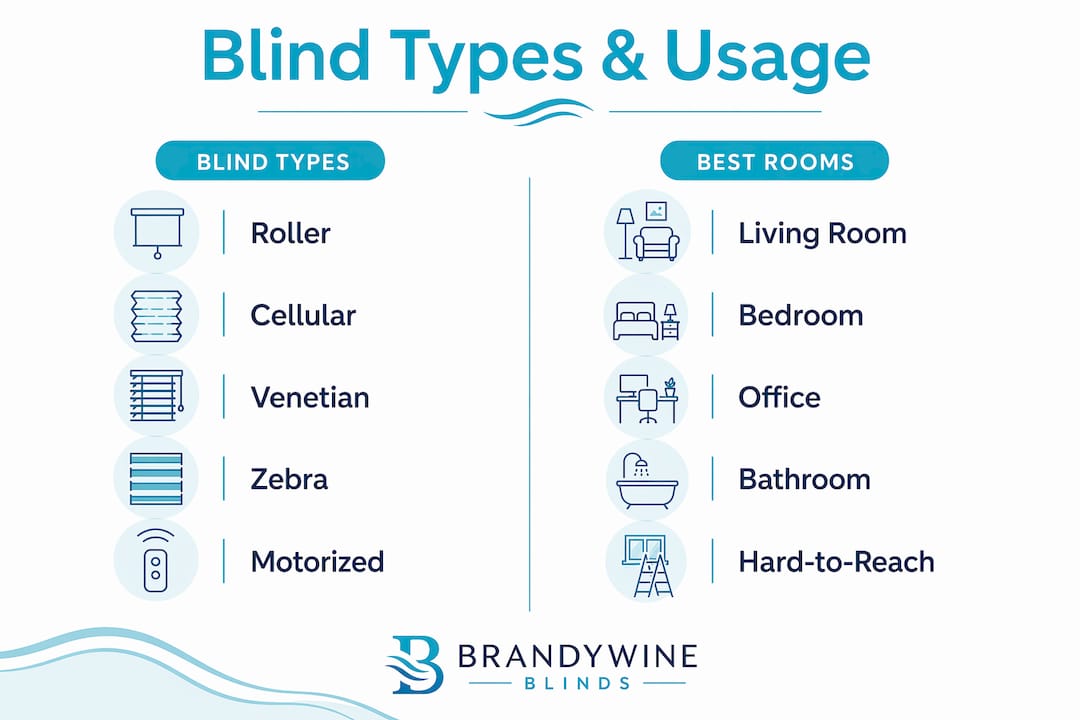
Five blind categories cover the needs of most first homes. Each has a clear strength, and knowing those strengths saves you money and frustration.
Roller Blinds are cost-effective and versatile, making them a solid default for living rooms, offices, and hallways. They offer a minimalist look and solid privacy, but they provide less insulation than cellular shades. If budget is your main concern, roller blinds are the best blinds for a first house across multiple rooms.
Cellular (Honeycomb) Shades are the top choice for energy efficiency. Their honeycomb structure traps air, creating a buffer between the glass and your living space. Double-cell versions offer enhanced insulation, though single-cell shades with larger cells handle most homes well. Bedrooms and south-facing windows benefit most from cellular shades.
Venetian Blinds give you precise light control through adjustable slats. They work well in living rooms and home offices where you want to shift from full brightness to filtered shade throughout the day. Faux wood Venetian blinds hold up better in humid rooms than real wood versions.
Zebra (Layered) Shades alternate between sheer and solid fabric bands. You align the bands to filter light softly or shift them to block it entirely. These layered shades suit living rooms and dining areas where you want flexibility without sacrificing style.
Motorized Blinds are the most convenient option for hard-to-reach windows and for households with children or pets. Motorized systems allow scheduled adjustments, which means your blinds open and close consistently without you touching them. That consistency also improves insulation and light control over time. You can explore motorized window treatments as a long-term investment that pays back in comfort and safety.
Blind Type | Best Room | Key Strength | Weakness |
Roller | Living room, office | Affordable, clean look | Low insulation |
Cellular | Bedroom, south windows | Best energy efficiency | Higher cost |
Venetian | Office, living room | Adjustable light control | Dust accumulation |
Zebra/Layered | Dining, living room | Versatile light filtering | Limited blackout |
Motorized | Any hard-to-reach window | Convenience and safety | Highest upfront cost |
Pro Tip: If you have young children or pets, start with cordless or motorized blinds throughout the home. Accessible cords are a strangulation hazard, and eliminating them from day one is far easier than replacing blinds later.
Inside mount vs. outside mount: which should you choose?
Mounting style affects how your blinds look, how much light they block, and how well they insulate. The two options are inside mount and outside mount, and neither is universally better.
Inside mount fits the blind inside the window frame. It creates a clean, built-in appearance and shows off decorative window trim. This option works best when your window recess is at least 2.5 inches deep. Shallow recesses force the blind to protrude, which defeats the purpose of the clean look.
Outside mount positions the blind on the wall above and around the window frame. Outside mounts overlap the window opening by 2–3 inches on each side to minimize light gaps and increase privacy. This is the better choice for windows with shallow recesses, uneven frames, or when you want the window to appear larger than it is.
Here is how mounting choice affects key performance factors:
Factor | Inside Mount | Outside Mount |
Light blocking | Moderate (gaps at edges) | Strong (overlaps frame) |
Privacy | Good | Better |
Visual effect | Clean, built-in | Window appears larger |
Best for | Deep recesses, trim display | Shallow frames, uneven openings |
Measuring correctly matters more than most new homeowners expect. For inside mounts, measure width at the top, middle, and bottom of the opening, then use the narrowest measurement. For outside mounts, add 3–4 inches to each side of the frame and 2–3 inches above.
Pro Tip: Always measure each window individually. Windows in the same room are rarely identical, even in new construction. A difference of a quarter inch changes your blind size and your light gaps.
What materials work best for blinds in a first home?
Material choice determines how long your blinds last, how easy they are to clean, and whether they hold up in humid rooms like kitchens and bathrooms.
Faux wood resists moisture and warping, making it the best choice for bathrooms and kitchens. It looks like real wood but costs less and cleans with a damp cloth. You can read more about the difference in the real wood blinds guide from Brandywineblinds.
Aluminum is lightweight, affordable, and moisture-resistant. It works well in kitchens and utility rooms but dents more easily than other materials.
Vinyl is the most budget-friendly option and cleans easily. It suits high-traffic rooms but can yellow over time in direct sunlight.
Fabric adds warmth and texture to living rooms and bedrooms. Fabric blinds absorb moisture and are less durable in humid areas, so keep them out of bathrooms and kitchens.
Bamboo offers a natural, textured look for living spaces. It filters light softly but provides limited blackout capability and is not moisture-friendly.
Safety is a separate material consideration. Cordless and motorized blinds are the safest choices for homes with children or pets. Corded blinds create a strangulation risk, and the Consumer Product Safety Commission has issued repeated warnings about this hazard. Cordless versions cost only slightly more and remove the risk entirely.
How do blinds improve energy efficiency and privacy?
Blinds are a practical tool for reducing your heating and cooling costs, not just a decorative choice. The right blind in the right room can make a measurable difference in your utility bills.
Choose cellular shades for bedrooms and south-facing windows. Their honeycomb structure traps air between the glass and room, reducing heat loss in winter and heat gain in summer. Double-cell shades perform better than single-cell in extreme climates.
Use blackout shades in bedrooms and media rooms. Blackout shades block nearly all light and solar heat gain, giving you both privacy and thermal resistance. Light-filtering shades suit living spaces where you want soft daylight without full exposure.
Fit your blinds precisely to reduce edge gaps. Light gaps at the sides of a blind are also air gaps. Outside mounts with a 2–3 inch overlap close those gaps and improve insulation performance.
Pair blinds with window caulking for maximum savings. Window caulking combined with energy-efficient blinds can significantly reduce home heating and cooling costs. Sealing drafts at the frame level and blocking heat transfer at the glass level work together.
Use motorized blinds for consistent positioning. Motorized systems let you schedule your blinds to close during peak sun hours and open when natural light is welcome. That consistency compounds into real energy savings over a full year.
For privacy, the best approach depends on your street exposure. Rooms facing a sidewalk or neighbor’s window benefit from light-blocking shades that allow you to see out without being seen. Sheer shades provide daytime privacy in lower-traffic rooms without sacrificing natural light.
How to mix blind styles throughout your home
Mixing blind types by room function is the approach that top blinds for first-time homeowners consistently recommend. You do not need a single style to create a cohesive look. You need a clear logic for each room.
Bedrooms: Cellular shades or blackout roller blinds for insulation and sleep quality.
Kitchens and bathrooms: Faux wood or aluminum Venetian blinds for moisture resistance and easy cleaning.
Living rooms: Zebra shades or Venetian blinds for adjustable light and style. Custom blinds for living room windows give you more sizing and color options than off-the-shelf products.
Home offices: Roller or Venetian blinds that reduce screen glare without blocking all natural light.
Hard-to-reach windows: Motorized blinds for skylights, high windows, or any opening above a staircase.
Balancing cost across a full home is a real concern for new homeowners. Prioritize cellular shades and motorized options in rooms where you spend the most time, and use roller or vinyl blinds in utility spaces and guest rooms. That split lets you invest where it counts without overspending on every window.
Pro Tip: Order fabric swatches or material samples before committing to a full purchase. Colors look different under artificial light than in a showroom, and a sample against your wall saves you from an expensive return.
Key takeaways
Choosing blinds for your first home requires matching each room’s function to the right blind type, mount style, and material before you buy anything.
Point | Details |
Match blind type to room function | Use cellular shades in bedrooms, moisture-resistant blinds in kitchens and baths, rollers in living spaces. |
Mounting style affects performance | Outside mounts block more light and suit shallow or uneven frames; inside mounts suit deep recesses. |
Material determines durability | Faux wood and aluminum handle humidity; fabric and bamboo suit dry living areas only. |
Cordless and motorized improve safety | Eliminate cord hazards from day one, especially in homes with children or pets. |
Blinds and caulking work together | Pairing energy-efficient blinds with sealed window frames delivers the greatest utility savings. |
What i’ve learned after helping hundreds of first-time homeowners
New homeowners almost always underestimate two things: how much light gaps matter and how quickly they regret cheap materials in the wrong rooms. I have seen beautiful fabric blinds installed in a kitchen, only to be replaced within 18 months because they absorbed grease and moisture and could not be cleaned. The fix cost more than doing it right the first time.
My honest recommendation is to start with cordless or motorized systems wherever you can. The safety benefit alone justifies the cost, and the convenience of scheduled adjustments is something you will use every single day. People who install corded blinds often tell me they forget to adjust them, which means they lose both the energy benefit and the privacy benefit.
The other mistake I see constantly is undersizing blinds to save money. A blind that does not fully cover the window frame looks wrong and performs poorly. Outside mounts with a proper overlap are almost always the better call, especially in older homes where frames are rarely perfectly square.
If you are in the Chester County or Downingtown area, I always recommend talking to a local window treatment specialist before ordering anything custom. A professional measurement takes 20 minutes and prevents the most common and costly mistakes new homeowners make.
— Dave
See what Brandywineblinds can do for your new home
Brandywineblinds has spent over 30 years helping homeowners in West Chester and Downingtown, PA find window treatments that fit their space, budget, and lifestyle. Their local experts measure every window precisely and guide you through options including cellular shades, roller blinds, motorized treatments, and plantation shutters, all at prices typically 30% lower than big box competitors.

Whether you need energy-efficient cellular shades for your bedrooms or light control solutions for your living areas, Brandywineblinds offers custom fits backed by a lifetime service warranty. Schedule a free in-home consultation and get the right blinds installed correctly the first time.
FAQ
What are the best blinds for a first home?
Cellular shades and roller blinds are the top blinds for first-time homeowners because they balance cost, performance, and ease of installation. Cellular shades work best in bedrooms; roller blinds suit living rooms and offices.
How do i measure windows for new blinds?
For inside mounts, measure width at three points and use the narrowest. For outside mounts, add 3–4 inches to each side of the frame and 2–3 inches above the opening.
Are cordless blinds worth the extra cost?
Yes. Cordless blinds eliminate strangulation risks for children and pets and cost only slightly more than corded versions. They are the recommended standard for any home with young children or animals.
Which blind material is best for kitchens and bathrooms?
Faux wood and aluminum are the best materials for humid rooms. They resist moisture, wipe clean easily, and do not warp or absorb odors the way fabric blinds do.
Do blinds actually reduce energy bills?
Cellular shades with a proper fit and outside mount can reduce heat transfer through windows. Pairing them with window caulking compounds the savings by sealing drafts at the frame level.
Recommended
Comments